Blog – Championing teacher wellbeing in schools

Championing teacher wellbeing in schools: Practical steps for change
When it comes to teacher wellbeing, a plate of biscuits in the staffroom (whilst always appreciated) is not going to fix the problem of burnout in massively overworked teachers. With recent surveys showing over 90% of teachers experiencing moderate to high burnout, it’s clear that the responsibility of staff wellbeing cannot simply be delegated to one, lone coordinator. Instead, any strategy has to be actively driven by senior leaders through both cultural shifts and smart structural changes.
Addressing burnout
Burnout is not just about feeling physically exhausted; it is also fuelled by emotional detachment and feeling like you are no longer making a meaningful difference. To combat this, it’s important to recognise the power of collective efficacy: the shared belief that, by working together, staff can overcome challenges and make a genuine, positive impact in their work. When collective efficacy is high, teachers feel connected, supported, and resilient; when it’s low, cynicism and an “us versus them” attitude quickly divides leadership teams from staff.
So, how can leaders actively grow collective efficacy in their schools? Here are some tips from Dr Carol Stahan:
Use appreciative inquiry
- Rather than relying solely on surveys, facilitate group conversations to unpick what is already working well and build upon those strengths
Show everyday appreciation
- Make gratitude part of your school’s DNA, whether through peer-to-peer shout-out boards in the staffroom or quick thank-you emails recognising a colleague’s help.
Develop a shared understanding of wellbeing
- Recognise that wellbeing looks different for everyone, and develop a shared, stigma-free language around stress and recovery.
Promote shared learning
- Create spaces for teachers to learn from one another through peer supervision, coaching, and collaborative problem-solving rather than top-down directives.
Reducing workloads
But cultural warmth must be backed up by practical, structural action. With workload being the biggest factor contributing to poor teacher wellbeing, protecting staff time and demonstrating genuine professional trust remain key. Here Adam Gillet provides some very practical examples:
Audit your school calendar and IT systems
- Spend time planning the annual school calendar to ensure there are no obvious or avoidable clashes that would increase teacher workload exponentially. Similarly, review and streamline the schools’ IT systems so teachers aren’t wasting time repetitively recording the same information.
Introduce flexible PPA
- Consider timetabling PPA time for the final period of the day, enabling teachers to head home early once a week. Trusting professionals to manage their own time can build both trust and goodwill.
Review teacher duties
- A teacher’s primary focus is to teach. By taking covering secondary responsibilities, like lunch cover, detentions and bus duties, senior leadership teams can show their commitment to ‘appreciate, not delegate’ and allow teachers to concentrate on their teaching and pastoral roles.
Cut low-impact tasks
- Consider how eliminating time-consuming duties with low educational return, such as formal report writing or lesson observations, can be replaced in ways that align with better staff wellbeing.
Two-way communication
Of course, none of the above should be simply imposed upon staff and senior leaders should not assume that they know what is best for their staff. When introducing new ideas, authentic consultation is vital. Setting up a staff wellbeing group and providing them with an actionable budget helps give teachers a real voice. Framing any major shifts in working habits (like flexible PPA) as ‘trials’ can also help lower resistance towards the initiatives and invite honest and constructive feedback.
Conclusion
Ultimately, teacher wellbeing is not necessarily about grand and expensive gestures. When school leaders consult and listen carefully to their staff, strip away as much unnecessary workload as possible, and promote a culture of trust, appreciation and belonging, they create an environment where teachers feel valued and thrive. And who wouldn’t want that?
Webinar speakers
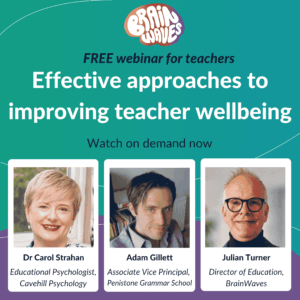
With thanks to Dr Carol Strahan and Adam Gillett who appeared on the BrainWaves webinar ‘Effective approaches to improving teacher wellbeing’. You can watch the webinar recording here.
Dr Carol Strahan
- is an Educational Psychologist and Director at Cavehill Psychology in Northern Ireland. She has more than 15 years’ experience working across education systems, including leading large-scale, funded staff wellbeing initiatives with schools and school leaders. Carol specialises in staff wellbeing, burnout prevention, school culture and psychologically informed training for schools and education settings.
Adam Gillet
- is Associate Vice Principal for Personal Development at Penistone Grammar School, Sheffield. In 2024 won the won the Inspirational Educator Award (in Mental Health in Education) for his work at Penistone transforming the school’s approach to mental health and staff/student wellbeing. He is also the author of Opening the CAGE: A Framework for Teacher Wellbeing, which provides practical strategies to reduce teacher burnout.
Blog – Bringing nature into your school
Bringing nature (and wellbeing!) into your school
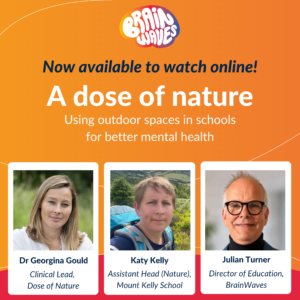
The BrainWaves webinar on “A dose of nature: Using outdoor spaces in schools for better student wellbeing” brought together two leading experts in nature-based interventions: Dr. Georgina Gould (Clinical Lead at Dose of Nature) and Katy Kelly (Assistant Head (Nature) at Mount Kelly School). Together, they shared fascinating insights and simple, scalable strategies for embedding nature into school environments.
The science: What happens when we step outside?
Many of us (including young people) intuitively feel that spending time outdoors is good for us, but understanding the underlying physiological and psychological mechanisms that happen to our minds and bodies when we step outside is crucial to young people in validating why nature connection is essential for learning and mental wellbeing.
1. Being outside calms the nervous system
When we step outside into natural surroundings, the parasympathetic nervous system is activated, reducing the body’s “fight, flight, or freeze” response. Adrenaline and cortisol levels drop, the heart rate variability settles, and blood pressure decreases.
When we are stuck in fight-or-flight mode, the prefrontal cortex—the part of the brain responsible for rational thinking, emotional regulation, and decision-making—simply shuts down to focus on the danger at hand. By settling the nervous system, nature re-engages the cortex, allowing us to think more clearly, focus, and regulate our emotions effectively.
This is particularly important when many of the “fight, flight, or freeze” responses in today’s society are not caused by genuine dangers, but rather the perceived stresses of modern day life.
2. Fractal patterns lead to wakeful relaxation
Nature is filled with fractals—self-repeating, complex geometric patterns found in things like leaf veins, tree branches, clouds, and river systems. Research demonstrates that viewing fractal patterns boosts alpha brain waves. Alpha waves induce a state known as wakeful relaxation: a unique mental zone where we feel calm and relaxed yet alert, inspired, and motivated.
3. Natural environments restore our attention and provide grounding and connection
According to Attention Restoration Theory, natural environments allow our directed attention (the focus required to read, complete coursework, or listen to a teacher) to rest and recover. Stepping outdoors restores cognitive capacity, reducing mental fatigue and “brain fog”.
Being in nature can also provide a sense of stability and permanence. For young people experiencing loneliness, stress, or emotional turbulence, natural spaces offer a safe, reliable anchor that fosters belonging and reduces feelings of isolation.
Practical ideas for the classroom and beyond
A key theme within the webinar highlights that you don’t need access to expansive national parks or vast green estates to cultivate nature connection. Small, intentional daily moments in nature can still make a substantial impact on wellbeing.
Suggested activities
- The wonder walk: Take a brief 5-minute walk around the school grounds and encourage students to find something that makes them pause and go “wow”.
- A rainbow walk: Challenge pupils to spot something in nature corresponding to every colour of the rainbow.
- Fractal scavenger hunts: Have students search for repeating patterns in tree bark, leaves, or frost on windows.
- Cloud or stargazing: Incorporate short, mindful outdoor pauses during transition periods or form time to observe the sky.
Urban and low-space solutions
- Micro-nature: Notice things like weeds pushing through pavement cracks, spiders in corners, or birds visiting rooftops.
- Bringing the outdoors in: Bring seasonal resources, like autumn leaves or pinecones, indoors for math activities, creative writing, or art projects.
- Window gardening: Grow sunflowers, herbs, or houseplants on windowsills inside classrooms to let students witness seeds transform into flowers.
- Leveraging tech: Use free identification apps like Merlin (for identifying bird calls) or Seek to gamify nature discovery responsibly.
Overcoming common school barriers
- Wet or cold weather clothing: Hold a Welly Amnesty! Ask your local community or parents to donate unused rain boots and coats. Mount Kelly collected over 100 pairs of wellies in just two days to outfit entire year groups.
- Teacher confidence: Start a Staff Nature Chat on Microsoft Teams or Slack. Encourage teachers, support staff, and caretakers to share photos, activities, and successes. Seeing colleagues take small steps normalizes outdoor teaching.
- Limited time / academic demands: Nature integration doesn’t require hour-long outdoor trips. Utilise 5-minute slots during form times, take one-on-one student check-ins on a short walk outside, or conduct brief brain breaks under the sky.
Key takeaways
Here are Georgina and Katy’s top tips for implementing nature education in your school:
- Shift the staff culture first: Build nature connection into the staff community before expecting full integration across the curriculum. When staff experience the benefits, it naturally filters down to students. And naturally, staff will feel the benefits too.
- Focus on connection, not just time spent outside: Simply being outdoors while distracted by a phone or worrying isn’t enough. Guide students to pay attention with their senses—listening to bird songs, observing patterns or feeling the wind.
- Just give it a try! Stepping out of traditional classroom routines can feel unfamiliar to many teachers at first, but both teachers and young people respond positively when given the opportunity to reconnect with the world under the sky.
And remember, by taking that first step into nature, you aren’t just stepping outside the classroom—you are opening up a lifelong pathway toward resilience, curiosity, and mental wellbeing for every young person in your care.