Wellbeing lessons available

BrainWaves is delighted to present a free wellbeing curriculum for use across secondary schools and sixth forms.

The lessons are based on the latest research and evidence around teenage mental health and have been approved by educational and psychiatric experts at the University of Oxford.

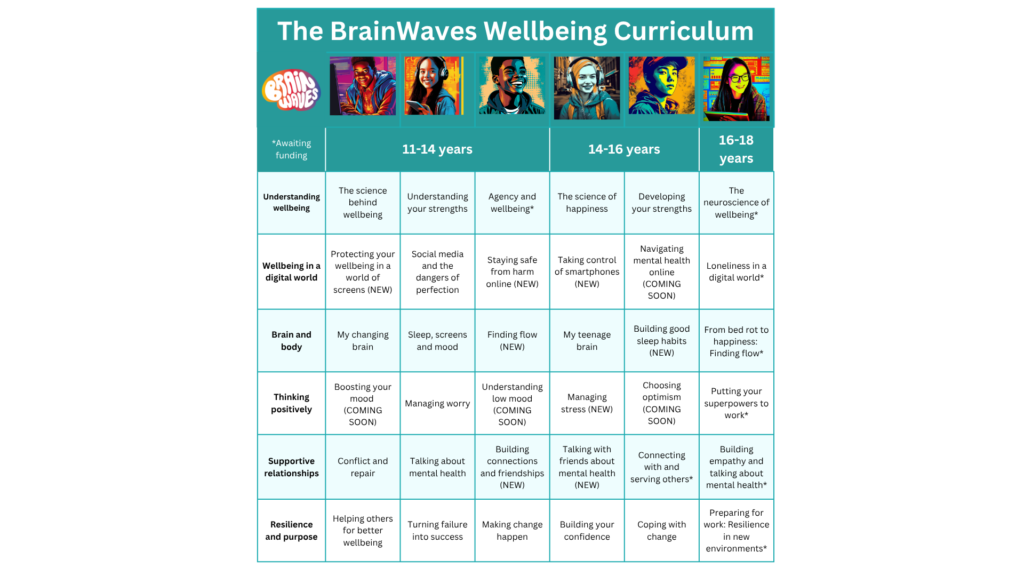
Building on the concept of positive psychology, these lessons are designed to give young people increased agency in managing their mental health, as well as a sense of optimism for change based on the practical application of wellbeing strategies.

You can see how the lessons fit together and which lessons are currently available by downloading this handy guide below, which breaks down the curriculum by age range.
Featured lessons

Take a look inside our wellbeing lessons. They are designed to be:

  • Empowering: helping students develop critical thinking and information evaluation skills, choosing strategies that are right for them.
  • Active: learning aims to be active and student-centred, with lots of scenarios, reflective thinking and group discussions.
  • Practical: providing at least one practical, evidence-based strategy per lesson for students to help support their wellbeing.

You can read more about the rationale for the curriculum and how it was developed here.

BrainWaves 11-14 wellbeing curriculum

There are currently 16 lessons available for students aged 11-14 years (Key Stage 3).

Subject to funding, more will be available from 2027 onwards.

11-14 Connections and friendships

Help students understand the important of social connection and how to develop friendships.

11-14 Challenging negative thoughts

Help students identify negative thoughts and use positive self-talk to improve their wellbeing.

11-14 Conflict and repair

Help students understand ways of dealing with conflict and repairing relationships.

11-14 Finding flow

Explore with students what ‘flow’ is all about and how flow activities can help improve wellbeing.

11-14 Helping others for better wellbeing

Explore with students the positive impact that kindness and helping others can have on wellbeing.

11-14 Making change happen

Help students set and use SMART objectives as a way of reaching their goals and making positive changes to their wellbeing.

11-14 Managing worry

Introduce students to a range of strategies that help them understand and deal with everyday worries and anxiety.
Brain

11-14 My changing brain

Discover how the teenage brain changes through adolescence and the impact this has on wellbeing.

11-14 Protecting your wellbeing in a world of screens

Empower students to set healthy digital boundaries and protect their wellbeing against excessive screen use.

11-14 Sleep, screens and mood

Explore how sleep and screens can impact students' mood and wellbeing.

11-14 Social media and the dangers of perfection

Help students understand how comparing themselves with highly-edited images on social media can affect their self-esteem.

11-14 Staying safe from harm online

Help students protect themselves from dangerous and harmful content online.

11-14 Talking about mental health

Help students take that important first step in reaching out to talk about their mental health.
Teenage boy

11-14 Turning failure into success

Help students discover the key resilience concepts of grit and a growth mindset.
Teenage girl

11-14 Understanding your strengths

Introduce students to the concept of character strengths and using them to promote better wellbeing.
Teenage boy

11-14 The science behind wellbeing

Help students explore the evidence behind the concepts of happiness and wellbeing.

BrainWaves 14-16 wellbeing curriculum

There are currently 9 lessons available for students aged 14-16 years (Key Stage 4).

Subject to funding, more will be available from 2027 onwards.

Teenage girl

14-16 The science of happiness

Help students discover the research and evidence behind what it means to be happy.

14-16 Developing your strengths

Remind students of the concept of character strengths and how they can influence our wellbeing.
Teenage boy

14-16 My teenage brain

Help students understand the neurological changes that are taking place inside their brain.

14-16 Building your confidence

Explore with students the difference between self-confidence, self-esteem and self-acceptance.
Teenage girl

14-16 Coping with change

Help students understand how they can manage both planned and unexpected changes in a positive way.

14-16 Taking control of smartphones

Help students understand what they can do to protect their wellbeing and reduce time spent on phones.

14-16 Managing stress

Help students understand both short- and long-term stress, and how to use a range of techniques to combat the effects of both.

Teenage boy

14-16 Talking to friends about mental health

Gives students the tools they need to talk with their friends about mental health issues.

Pop art image of teenage boy asleep

14-16 Building good sleep habits

BrainWaves 16-18 wellbeing curriculum (LEAVING SOON)

We are always looking at updating and refreshing our lessons and subject to funding, we will be releasing new Key Stage 5 lessons in early 2027. Following this release, we will look to retire the lessons listed below.


16-18 The psychology of wellbeing

Help students understand the psychological theories behind wellbeing and flourishing.

16-18 Recap on the teenage brain

Help teenagers understand the changes that take place in their brain during adolescence and how this affects their mental health.

16-18 Sleep and teenagers

Explore how sleep pattern and hormones change for adolescents and how teenagers can get more sleep.
Teenage girl looking stressed

16-18 Managing stress

Capture what students have already learnt about stress management and bolster their knowledge about relaxation techniques.

16-18 Having a conversation about mental health

Give students the confidence to start a conversation about mental health and know how to support their peers in return.
Older teenage girls with sporting equipment around here

16-18 Boosting your mood

Show students how to use behavioural activation to deliberately boost their mood when feeling down or depressed.

BrainWaves 16-18 wellbeing curriculum (COMING SOON)

Using feedback from the current lessons, we plan to update our Key Stage 5 provision and new lessons will be available soon.

Coming soon

16-18 Building empathy and talking about mental health

Coming soon

16-18 From bed rot to happiness: Finding flow

Coming soon

16-18 Loneliness in a digital world

Coming soon

16-18 Preparing for work: Resilience in new environments

Coming soon

16-18 Putting your superpowers to work

Coming soon

16-18 The neuroscience of wellbeing