
Blog – New Lessons: Wellbeing in a Digital World

Supporting Young People Online: New BrainWaves Lessons on ‘Wellbeing in a Digital World’
At BrainWaves, our mission is to improve adolescent mental health and wellbeing in schools by bridging the gap between high-level research, and the daily realities of the classroom.
As technology continues to be an ever-present part of young people’s lives, schools need to continue navigating conversations around smartphones, social media, screen time, and online safety.
These topics can feel complex, fast-moving, and difficult to address, which is why we’ve developed a series of free lessons on Wellbeing in a Digital World as part of our wider wellbeing curriculum.
Grounded in the latest research from the University of Oxford, these evidence-informed lessons give teachers the tools to approach these important issues with confidence, whilst giving students practical strategies to build healthier digital habits:
- Protecting your wellbeing in a world of screens (11-14 years)
- Staying safe from harm online (11-14 years)
- Social media and the dangers of perfection (11-14 years)
- Taking control of smartphones (14-16 years)
Helping Young People Navigate the Digital World
Rather than suggesting an outright ban and encouraging students to avoid smartphones altogether, our curriculum helps them understand and navigate the digital world: how digital environments are designed, how online experiences can affect their wellbeing, and what they can do to stay in control.
Designed as part of a spiral curriculum, these lessons can be taught either in progression through the five years of secondary school or as stand-alone lessons throughout the key stages.

Lesson one: Protecting your wellbeing in a world of screens
(For ages 11–14)
Not all screentime is equal, and this lesson helps students understand the difference.
At this age, young people are using screens in a very different way to older teenagers. Students therefore explore how active screen use, such as creating, communicating, or learning, can have more positive effects on their wellbeing, compared with passive scrolling and endless consumption. The lesson also introduces the idea of “displacement”, helping students recognise the dangers of screentime when it replaces activities known to protect mental health, such as sleep, exercise, and spending time with others.

Lesson two: Social media and the dangers of perfection
(For ages 11–14)
Social media can be a great way to connect with others, but it can also create unrealistic expectations and encourage unhealthy comparisons.
In this lesson, students explore why people naturally compare themselves to others and how carefully edited and curated content on social media can distort reality. The lesson encourages students to recognise the impact this can have on their self-esteem and wellbeing, while equipping them with practical strategies to develop a healthier perspective and create a more positive experience on social media.

Lesson three: Staying safe from harm online
(For ages 11–14)
This lesson explores the realities of harmful online content and how young people can respond safely and confidently when they encounter it.
Introduced in a safe and non-frightening way, students learn about the role algorithms can play in exposing them to unwanted or harmful material, even when they are not actively searching for it. They are introduced to a simple framework, Curate and Protect, Block and Report, Get Help Now, which gives them practical actions to take when faced with harmful content online. The lesson concludes with students creating their own online safety plan, encouraging them to reflect on their digital lives and identify personalised strategies for staying safer online.

Lesson four: Taking control of smartphones
(For ages 14–16)
Smartphone apps are deliberately designed to capture and hold our attention, so understanding how they work is the first step towards using them more intentionally.
Drawing on research from the University of Oxford, this lesson explores the motivations behind excessive phone use before introducing practical strategies that help students regain control of their digital habits. Students will learn how to protect the big 3 for wellbeing: sleep, physical activity, and real-life relationships. The lesson focuses on achievable changes such as creating phone-free zones, setting app limits, and adding small amounts of “friction” to reduce endless scrolling.

Evidence-Based Strategies for Lasting Wellbeing
By combining accessible research with engaging classroom activities, the BrainWaves Wellbeing Curriculum equips teachers with the confidence to deliver meaningful, up-to-date lessons while giving young people the knowledge and skills they need to build healthier relationships with technology and protect their wellbeing in a digital world.
To further support teachers, every lesson is accompanied by concise Research Guides that summarise the evidence behind each wellbeing strategy. From creating phone-free zones and reducing passive screen use to improving sleep habits and taking healthy breaks from social media, these guides ensure that every recommendation is grounded in robust psychological research.
To explore the full ‘Wellbeing in a Digital World’ theme and discover more evidence-informed lessons from the BrainWaves Wellbeing Curriculum, please visit here and create an account to access the free lessons:
https://education.brainwaveshub.org/brainwaves-lessons/
Blog – Launch of Living Well 2026
STOP GUESSING, START IMPACTING: BrainWaves Living Well Conference 2026
Early Bird Tickets are now LIVE!
We all see it every day: student mental health is declining, and the “solutions” offered often feel disconnected from the reality of a busy classroom.
On Monday, 6th July 2026, we’re changing that. In association with the University of Oxford, the BrainWaves Living Well Conference 2026 is bringing the world’s leading researchers and frontline educators into one room to bridge the gap between “knowing what works” and “making it work” in your school.
Why you need to be there
This isn’t just another theory-heavy seminar. It’s a day of actionable impact designed specifically for school leaders and teachers.
- Evidence-based strategies: Get direct access to the scientists behind the studies.
- Classroom realities: Focus on the issues that matter now, including the impact of social media and the psychological roots of persistent absence.
- Neurodiversity & wellbeing: Join interactive roundtables on the rise of neurodiverse diagnoses and how we accurately measure student wellbeing.
The Programme: Research you can actually use
Our line up of speakers is lead by world-renowned scientists from the University of Oxford (more speakers to be announced soon!) exploring the conference theme of ‘Shifting the curve in adolescent mental wellbeing‘:
- Population insights: Big-picture trends with Prof. John Gallacher (University of Oxford).
- Self-harm and adversity: Critical insights from Prof. Sarah Bauermeister (University of Oxford).
- Social media and devices: Separating myth from reality on the impact on young people.
- The attendance gap: Understanding the “why” behind school avoidance.
Lock in Your Early Bird Discount by 30th April!
Don’t wait for the budget to tighten. Secure your spot at the best rate by the Early Bird Deadline of 30th April 2026 and join a community dedicated to actually ‘shifting the curve’ on adolescent mental health.
Event Date: 6th July 2026
Location: Prospero House, London, SE1 1GA
👉 CLICK HERE TO FIND OUT MORE ABOUT THE CONFERENCE
👉 OR CLICK HERE TO SECURE YOUR EARLY BIRD TICKETS NOW
Blog – World Mental Health Day 2025
World Mental Health Day 2025
The World Health Organisation recognises World Mental Health Day on 10 October every year. This year’s theme is ‘Make mental health and wellbeing for all a global priority’.
As students continue to face growing pressures, academically, socially, and emotionally, we’re reminded how vital it is that all young people have access to consistent, high-quality mental wellbeing support and education in school.
At BrainWaves, our mission is to make this support both accessible and effective. Our free, evidence-based Wellbeing Curriculum provides a series of lessons that equip students with practical strategies to manage their mental wellbeing. Best of all, these oven-ready lessons are designed to fit seamlessly into your PSHE planning.
Key wellbeing lessons for Mental Health Week
The following lessons can be used at any stage across Key Stage 3, or with students aged 11-14 years and can be used to help students understand what impacts their wellbeing, as well as ways in which they can change their behaviours for better wellbeing.
- Managing Worry: Learn a variety of techniques to tackle everyday worries.
- Challenging Negative Thoughts: Discover strategies to transform unhelpful thinking patterns.
- Sleep, Screens, and Mood: Understand how use of screens and bedtime routines impact mood, wellbeing, and sleep quality.
- Social Media Social Media and The Dangers of Perfection: Explore how social media affects our sense of self and how to navigate it positively.
- Helping Others for Better Wellbeing: Engage in activities that highlight the power of kindness and altruism.
- Making Change Happen: Empower students with tools to make lasting, positive changes in their lives.
These lessons are tailored to help students understand their emotions, reflect on their experiences, and develop a stronger sense of agency over their mental health, all in an age-appropriate, evidence-based format.
Join our free webinar
To support your school further in supporting wellbeing in your school, we’re hosting a free CPD webinar for educators: “Unlocking wellbeing: The power of creativity on young people’s mental health and wellbeing”.
In this session, we’ll explain about ‘creative health’ and how the use of creative and cultural activities can be used in secondary schools to support adolescent wellbeing. Professor Neil Humphrey will talk about the research he has conducted with the Factory International Schools Programme and the outcomes it has had on the young people involved.
Become a BrainWaves Research Partner
Working alongside the University of Oxford, our Research Partners are helping to shape the future of mental health education. By joining us, you’ll be contributing to one of the UK’s largest studies into adolescent wellbeing and helping us build a better understanding of what young people need to thrive.
We’re currently inviting UK-based schools and colleges with 16+ provision to join this vital work!
If you’re interested in bringing BrainWaves to your school or college, or becoming a Research Partner, get in touch with our team at support@brainwaveshub.org.uk.
Together, let’s change the story on youth mental health, starting in the classroom!
About the author

Abbie Simpkin is a School Research Liaison Manager at BrainWaves, responsible for supporting schools on the BrainWaves Research Programme. She was previously a music teacher at Key Stage 3-5.
Blog – KS3 curriculum & statutory requirements
Supporting mental wellbeing at KS3: Statutory requirements and the BrainWaves lessons
Promoting mental wellbeing in schools is a statutory responsibility, as outlined in the DfE guidance on Relationships Education, Relationships and Sex Education (RSE), and Health Education, which establishes mental wellbeing as central to supporting pupils’ health, happiness, and academic success.
For secondary schools, this presents both an opportunity and a challenge. Teachers must ensure that their delivery not only meets statutory requirements but also equips students with the practical skills and emotional literacy needed to manage the complexities of adolescence.
The BrainWaves KS3 programme provides a free, comprehensive and structured approach that supports schools in fulfilling the DfE’s mental wellbeing curriculum. Designed for students aged 11–14, the BrainWaves lessons are grounded in positive psychology, cognitive behavioural theory, and adolescent brain development. The curriculum offers practical strategies for building resilience, promoting positive mental health, and helping students develop self-awareness, emotional regulation, and empathy — all central pillars of the statutory framework.
Understanding the statutory requirements
According to the DfE guidance, pupils should know:
- how to talk about their emotions accurately and sensitively, using appropriate vocabulary
- that happiness is linked to being connected to others
- how to recognise the early signs of mental wellbeing concerns
- common types of mental ill health (e.g. anxiety and depression)
- how to critically evaluate when something they do or are involved in has a positive or negative effect on their own or others’ mental health
- the benefits and importance of physical exercise, time outdoors, community participation and voluntary and service-based activities on mental wellbeing and happiness.
These themes are not intended to be delivered in isolation, but embedded within a broader curriculum that supports personal development and emotional wellbeing. BrainWaves provides an ideal vehicle to meet these goals through its carefully designed sequence of lessons.
How BrainWaves aligns with statutory content
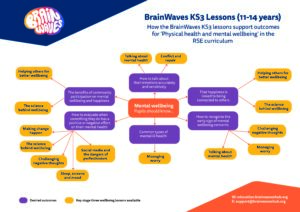
The BrainWaves KS3 programme currently comprises a series of 12 FREE lessons (with more to come in late 2025!), each tackling a specific aspect of mental wellbeing. Please click to download a copy of the map below:
1. Understanding and managing emotions
Lessons such as “Talking about Mental Health” and “Challenging Negative Thoughts” support students in developing emotional literacy — a critical first step in promoting wellbeing. These lessons encourage pupils to recognise their own emotional states, understand the cognitive distortions that can drive negative thinking, and practise techniques like positive self-talk and self-compassion.
These sessions align closely with the DfE requirement for pupils to be able to “talk about their emotions accurately and sensitively, using appropriate vocabulary.”
2. Recognising mental wellbeing concerns
The “Managing Worry” lesson equips students with the knowledge to distinguish between everyday worries and more serious mental health concerns. It introduces strategies such as the worry tree, problem solving, and breathing techniques, helping students become more self-aware and capable of intervening early when difficulties arise.
This directly addresses the statutory requirement for pupils to know how to “recognise the early signs of mental wellbeing concerns” and “how to manage common types of mental ill-health such as anxiety”.
3. Building purpose and connection
The lessons on “Helping Others for Better Wellbeing” and “The Science Behind Wellbeing” both highlight to young people the importance of purpose, community, and positive emotion in promoting happiness and resilience. Students explore how volunteering, acts of kindness, and gratitude practices can enhance their own wellbeing.
These sessions address the DfE requirement to show “the benefits and importance of physical, mental and emotional wellbeing and happiness through community participation and voluntary activity.”
4. Promoting resilience and a growth mindset
“Turning Failure into Success” and “Making Change Happen” tackle key themes such as grit, resilience, goal setting, and dealing with setbacks. These concepts are central to the DfE’s guidance, which emphasises helping pupils “build the confidence to persevere” and develop “resilience and character that we know are fundamental to being happy, successful and productive members of society”.
Incorporating techniques like SMART goal-setting and reframing failure as a learning opportunity, these lessons provide evidence-informed approaches to building personal strength and self-efficacy.
5. Supporting sleep and healthy habits
Modern adolescents are increasingly affected by disrupted sleep patterns, often influenced by screen use and digital behaviours. The “Sleep, Screens and Mood” lesson helps students understand the critical link between sleep and mental wellbeing, including the physiological effects of artificial light and the importance of sleep routines.
This lesson supports the requirement for pupils to understand “the importance of sufficient good quality sleep for good health and how a lack of sleep can affect weight, mood and ability to learn.”
6. Social media awareness and digital literacy
“Social Media and the Dangers of Perfection” offers a critical lens on the curated nature of social media and its impact on body image, self-worth, and mental health. Students are taught to recognise unrealistic portrayals online, control their social media feeds, and reflect on their digital habits.
This aligns with DfE guidance requiring schools to teach students about “the impact of unhealthy or obsessive comparison with others online” and how it can affect mental health.
7. Developing positive relationships and conflict resolution
The “Conflict and Repair” lesson explores strategies for navigating interpersonal challenges and repairing damaged relationships. Students learn about assertiveness, empathy, forgiveness, and effective communication — all skills that not only support mental wellbeing but contribute to healthy relationships.
This supports the DfE’s emphasis on equipping pupils with tools to manage “conflict, reconciliation and ending relationships” as well as developing empathy and understanding.
Additional benefits for schools
Beyond curriculum alignment, BrainWaves offers several practical benefits for schools:
- Evidence-based: The curriculum draws on robust psychological research, including cognitive behavioural theory, positive psychology, and neuroscience.
- Ready-to-use resources: All lessons are fully planned, with detailed overviews, teaching materials, and extension activities. Concise, one-page Research Guides also show the evidence and research behind each strategy taught in the lessons.
- Age appropriate: Lessons are designed specifically for the 11–14 age group, taking into account cognitive, emotional and social development during adolescence.
- Bonus lessons! Two additional lessons “Understanding my strengths” and “My changing brain” provide important content for young people on how hormonal changes impact their brain and ability to self-regulate emotionally, and how they can identify and use their strengths for better wellbeing. Both these lessons support young people with positive self-identity and self-awareness, character development, and confidence, which the DfE guidance recognises as essential components of promoting good mental health and personal resilience.
- PSHE Association links: As well as links to the statutory RSE guidance, each lesson is mapped to the PSHE Association Programme of Study, making integration into existing schemes of work straightforward.
Conclusion: A comprehensive solution for ‘mental wellbeing’ education
In an educational landscape where schools are increasingly held accountable for student wellbeing, BrainWaves provides a powerful, practical solution. It enables teachers to deliver the DfE’s statutory content with confidence, while also promoting meaningful engagement, emotional growth and resilience among students. For schools seeking to align their KS3 provision with national expectations — while genuinely making a difference to young people’s wellbeing — BrainWaves offers an invaluable starting point
About the author

Tracey Riseborough is Content Manager at BrainWaves, responsible for commissioning the BrainWaves curriculum and educational resources. As part of this work, she manages the termly evaluation of the lessons by BrainWaves Research Schools, where both students and teachers provide feedback on the quality and effectiveness of the lessons. If you’d like to find out more about how you can take part in this research, please contact support@brainwaveshub.org.
Blog – KS3 curriculum (May-25)
How BrainWaves is supporting student wellbeing in the classroom
In our webinar, “Learning to thrive in Key Stage 3: Teaching the BrainWaves wellbeing lessons”, we were joined by guest speakers, Louisa Anderson (Head of Citizenship & PSHE, Altrincham Grammar School for Girls) and Natalie Rodden (Educational Consultant). Both offered practical advice for teachers aiming to weave the BrainWaves KS3 wellbeing curriculum and mental health and wellbeing strategies into their classroom.
___________________________
Overview of our wellbeing curriculum
Our curriculum of free, evidence-based wellbeing lessons is available for use with Key Stages 3, 4, and 5 (ages 11-18). The curriculum has a focus on positive psychology and uses this approach to promote overall wellbeing, rather than focusing on specific mental health conditions. This aims to enhance and improve mental wellbeing for the entire student population.
A core aim of the lessons is to empower students by fostering a sense of agency and demonstrating that they can actively influence their own wellbeing.
Lessons incorporate scientific data as a starting point, ensuring that content is grounded in evidence. Research guides are also available to help teachers understand the science behind the lessons. Each lesson equips students with at least one practical strategy they can use to support their wellbeing.
Actionable tips for teachers
1. Start with the foundational lessons. During the webinar, our guests recommended beginning in Key Stage 3 with “The Science of Wellbeing“, a lesson that introduces the core concept of the PERMA framework (Positive Emotions, Engagement, Relationships, Meaning, Accomplishments). A second lesson, “My Changing Brain“, is recommended to help students understand neurological changes during adolescence.
2. Integrate into your existing curriculum. BrainWaves lessons can easily be integrated into various parts of the curriculum, such as PSHE or personal development. For example, “Conflict and Repair” can be used in relationship units, and “Understanding Your Strengths” in careers. You can also adapt and personalise each lesson to your students’ needs and classroom dynamics. Consider relevant issues and create a safe space for discussion.
3. Encourage action and reflection. Encourage your students to use the strategies learned in the lessons outside of the classroom, then take the time to review how successful they were in future lessons. Journaling works well for this level of reflection. Everybody is different, so reflect on what worked for some students and what works for others. Learning that wellbeing is not the same for everybody, and that it’s helpful to have a whole toolkit of wellbeing techniques for different stages of your life, is an important leaning point for young people.
4. Utilise the support materials. The BrainWaves lessons are particularly recommended by teachers because of their ‘oven-ready’ nature – minimal preparation time or knowledge is needed before delivering them to students. However, detailed teacher notes are available to guide you through each lesson, as well as concise research guides that highlight the evidence-base for each strategy covered. Making the most of these resources can really boost teacher confidence and make delivery of the lessons even more engaging!
By incorporating the BrainWaves wellbeing lessons into your teaching, you’re not only equipping your students with valuable tools to support their own mental health but also fostering a classroom culture that champions wellbeing as a shared priority. These lessons can be a powerful way to show young people that looking after their mental health is both achievable, important and within their control.
For more information or support with delivering the BrainWaves lessons, please email support@brainwaveshub.org
About the author
Abbie Simpkin is a School Research Liaison Manager at BrainWaves, responsible for supporting schools on the BrainWaves Research Programme. She was previously a music teacher at Key Stage 3-5.
Blog – Youth suicide prevention (Jan-25)
Youth suicide prevention: Top tips for schools
In a recent webinar, The C.A.R.E. Kit: Suicide prevention advice from CALM, we were joined by psychotherapist, Wendy Robinson, Director of Services at CALM (Campaign Against Living Miserably) to talk about the important topic of suicide prevention. Wendy introduced the C.A.R.E kit, a free resource which can inform you on how to take action as a trusted adult to protect young people from suicide.
We were also joined by Kristan O’Flynn, Deputy Head of Sixth Form and BrainWaves Lead at The Cooper School, who shared her insights and experience on the topic and inspired us to come up with these top tips for trusted adults in schools and colleges.
___________________________
1. Be visible
Being consistently present and reiterating that trusted adults are there to help is key to ensuring students know and understand ways in which they can access support.
Kristan shared a powerful example of this from The Cooper School. Following a weekend where there were two suicide-related instances directly and indirectly involving students, staff had an opportunity to stand united in front of the students in an assembly, acknowledge the incidents and share these key messages with their students:
- “You do not have to deal with anything that’s affecting you alone”
- “We are here to support you”
- “You are all worthwhile”
- “Your voices will be heard”
Taking the opportunity to simply be visible and present for the students led to an influx in students referring themselves to the school counsellor and the school nurse.
Wendy shared a helpful resource from PAPYRUS which recommends that schools and colleges have a suicide prevention policy statement which is known and visible to the whole school community. It provides a model policy statement and reference points which schools and colleges could use to review their existing document.
2. Don’t be afraid of the S-word: Suicide
Talking about suicide can feel uncomfortable and many people worry that they don’t have the appropriate skills and training to support someone dealing with suicidal thoughts or that talking about it might put ideas into a young person’s mind.
Wendy suggested that the only type of thing we shouldn’t say when talking to someone about suicidal thoughts is “You’re not thinking of hurting yourself, are you?” or “You’re not thinking of doing something silly, are you?” These types of phrases push the message that the struggling person should respond, “No,” which isn’t conducive to opening up a conversation with someone who actually might be dealing with these thoughts.
Stigma promotes silence. It is important to know that lots of people struggle: suicidal thoughts happen to 1 in 5 of us. Talking about it with appropriate language and normalising conversations around the topic might help reinforce that anyone experiencing suicidal thoughts can reach out for help without fear of the stigma often associated with it.
3. Be informed
You can help equip yourself by seeking out empowering information about suicide and suicide prevention such as that found in the C.A.R.E kit. The kit is full of information which can support you in approaching young people about their mental health, from prevention to crisis and at each point in between.
For example, during the webinar, Wendy shared a list of different words that young people might use to refer to suicide without using the word suicide, kill or other clearer terms. A particularly common term at the moment is “unalive” (the remainder of the shared list can be found at 45m 25s). These more obscure terms are used to avoid censorship, particularly online where using words such as suicide and kill could result in a post or comment automatically being deleted. Additionally, they are used to create a sense of solidarity between groups of people who can decode them. It is useful to familiarise yourself with these words and could be words you suggest to be monitored by IT teams at your school.
Another way you can be informed is by getting to know the young people you see on a regular basis. Look out for signs that someone might need help such as changes in behaviour, physical indicators and the words they use or emotions they display. Almost anything could be an indicator that someone is struggling. When we get to know young people, it will be easier to identify when something seems off and trust your intuition in exploring what might be going on.
4. Ask for help
Anyone working in education should be well aware of safeguarding policies and how to report anything of concern to safeguarding leaders at school. Kristan suggested a way to phrase this need for adults to get additional support when dealing with these types of situations by saying, “We both might need support, I might have to pass this on because I might not be the best person to help you.” This can help the young person to know that you are on their team and care about them.
Wendy suggested that it is the job of trusted adults to advocate for the young person, not to fix the problem. Best practice is to seek expert help to support the young person through an immediate crisis situation and beyond. Build a support network around the young person and also for yourself and don’t give up hope. The C.A.R.E kit includes a list of expert support services. BrainWaves lessons also include a list of places to get help at the end of each of our lessons.
This support network you help create will be key to starting the young person on a positive path.
Want to find out more?
We hope you found these top tips useful, you can find more in our C.A.R.E kit webinar. If you are interested in finding out more about CALM’s vision and mission, please visit their website www.thecalmzone.net.
About the author
Abbie Simpkin is a School Research Liaison Manager at BrainWaves, responsible for supporting schools on the BrainWaves Research Programme. She was previously a music teacher at Key Stage 3-5.
Blog – Top tips for positive emotions
Top tips for introducing ‘positive emotions’ into your classroom!
My name is Clare Marshall and I have been a teacher of psychology for over ten years. I have worked in schools and colleges in England and Spain and am currently completing my MSc in Applied Positive Psychology and Coaching Psychology at the University of East London.
I found Positive Psychology (PP) back in 2009 when completing my BSc in Psychology and Counselling and a whole new world of psychology opened up. I now take every opportunity to implement positive psychology into my teaching practice to improve student wellbeing and facilitate learning.
As a teacher I understand the phenomenal workload that we are all under, and the idea of ‘one more thing to do’ is the last thing anyone wants. However, positive psychology has been shown to improve wellbeing in many environments – so here are some easy, quick and inclusive activities to promote positive emotions for both students and staff!
My fabulous four positive emotion inducing activities are:
1. Asking ‘What Went Well’ (WWW)
This is sometimes called ‘Three Good Things’. I ask students to think about WWW from the last day/week (or however long you think is appropriate. We gave our students little notebooks where they could write down WWW/or three good things and then invite students to share with the class. Remember, these things can be something as small as someone saying ‘Hi’, or feeling happier because the sun is shining (which is sometimes quite rare!). The important thing is it focuses on the positive aspects of life rather than the negative and done regularly, trains our mind to think more positively.
2. Discussing student strengths
Values in Action (VIA) is a brilliant website that allows children and adults to complete a Signature Strength Test and find out what their top strengths are. Research shows that just being able to put a name to your strengths is empowering, and using your strengths in new ways increases positive emotions. Getting students to take the test, then talking with them regularly about how they have used their strengths throughout the week is a great way to produce positive energy and emotions.
3. Showing a funny YouTube clip
I often ask students to send me clips that they find funny – obviously that doesn’t always happen and so I do warn students that I will show something that *I think* is funny. They say laughter is contagious and quite often the students end up laughing at me laughing. Here’s one of my favourite clips.
4. Creating a ‘Wall of Joy’
This is not so much as something to do every day, but a great activity that induces positive emotions, and has a lasting effect. I asked students to send me a picture of something that brought them joy and then printed and laminated them and dedicated a whole wall of my classroom to things that brought us joy. I had everything from pets to Harry Styles and crystals it was fantastic! Seeing what brings joy and having a daily/weekly reminder was lovely and encouraged conversations around what brings us joy.
Some other suggestions
- Playing motivational music as students enter the classroom (or even a quick ‘name that tune’ game).
- 10 minutes board game time (could be as simple as playing UNO!)
- If practical, taking the lesson outside into the school grounds.
And of course, the free BrainWaves lessons include many activities which encourage wellbeing through positive psychology (i.e. journaling, looking at strengths, showing gratitude etc).
The effects of positive emotions in the classroom
Dr Barbra Fredrickson, who developed the Broaden and Build Theory is one of the worlds leading experts on the effects of positive emotions: her book ‘Positivity’ is a great read, and there is a wide body of empirical research to support the effects of positive emotions in the classroom, including:
- Creates a great inclusive learning environment! Laughter is universal and brings people together so it helps students to feel at ease and creates a great group atmosphere.
- Increasing positive emotions has a positive impact on learning because students are more likely to attend when they know they are guaranteed to do something that makes them feel good every lesson (even if it is the first five minutes, it all helps).
- Inducing positive emotions into lessons facilitates students in building long-lasting psychological strengths over time, and this helps with managing many of the stressors that come hand-in-hand with school or college, so students often become more confident and better at coping.
- As a teacher, knowing that you are inducing laughter or positive emotions is beneficial for our own wellbeing. Teaching, whilst fantastic, can be challenging and making a conscious effort to build positive emotions into lessons is a great habit to create and has a ripple effect.
- Inducing positive emotions impacts on our visual attention and cognition, when we feel positive emotions our visual field expands and we literally take in more of the world around us, and we tend to think more ‘outside the box’.
To learn even more about how to generate ‘positive emotions’ in schools, you can also watch our BrainWaves webinar with leading positive psychology expert, Professor Ilona Bonniwell.
About the author
Clare Marshall is a lecturer at Warrington & Vale Royal College.
Blog – Creating a safe space
A safe space for learning
How to create a classroom environment where students feel emotionally safe
Studies have shown that students with higher levels of emotional wellbeing learn better [1]. Learning only happens after students’ emotional needs are met: allowing them to take more risks, to be less afraid of failure, to push themselves and to be more engaged in lesson content. Incidentally, they tend to perform better academically too [2].
So, in a world where students are always connected to the news and social media, where climate change anxiety and pandemic hangovers weigh heavy, where fear of failure, friendship dynamics and the pressures of academia can all make life feel a bit unsure, how can you help your students feel emotionally safe in a classroom environment? Here is a list of some suggestions for creating an emotionally safe environment…
1. Show you value everybody

The cornerstone of emotionally safe classrooms are positive relationships where all participants feel heard and respected [3]. This can be encouraged by:
- Creating opportunities for meaningful discussion and debate, and offering conversation structures for students to use.
- Greeting students as they come into the classroom – you might be the first person who has spoken directly to them that day.
- Taking the time to get to know students individually and creating a sense of belonging and community, from celebrating birthdays to noticing and recognising their strengths. This should be done with every student – even the most challenging ones. Celebrating strengths with students and their parents is important, especially during difficult times.
2. Celebrate failures and success equally

In order to take risks and challenge themselves, students need to see learning as a process. They need to view failures as positive steps towards success and to know that a FAIL is simply a “First Attempt In Learning”! A culture that celebrates failures as well as successes will help students develop resilience and perseverance. In order to reinforce this further, you can:
- Help students change their dialogue from ‘I can’t do this’ to ‘I can’t do this yet’. That one word makes all the difference! [4]
- Model failure. This can be your own failure – making mistakes in front of your class can be opportunities to demonstrate how we can use them as stepping stones in learning. It could also be sharing stories of success after failure – like this video ‘How a Failed Invention Led to a Potentially Life-Saving New Idea’ or ‘Musharaf’s story from Educating Yorkshire’.
- When a student responds incorrectly to a question, focus on validating their answer and thanking them for engaging before redirecting. You could say, ‘I like where you’re going with that, let’s come back to it. Does anyone else want to share their thoughts?’ You could also encourage them to expand their thinking by asking questions such as ‘Have you considered this?’ or ‘That’s really interesting, thank you for inputting. Could you explain your thought process?’
3. Foster self-awareness

Research shows that ‘when students do not fully trust their abilities to perform their academic tasks, they show emotions such as boredom, anxiety, sadness, or frustration, and exhibit behaviours such as passivity, distraction, and mental detachment’ [5] – none of which are ideal building blocks for emotional security. To address this, you can:
- Incorporate positive language into everyday classroom routines to promote self-esteem. Here are some ideas for younger students that could be adapted for any age range.
- Use constructive feedback which includes something positive as well as steps for improvement.
- Use the free BrainWaves lessons that focus on self-awareness to build self-esteem, including:
At the beginning of each BrainWaves lesson, a slide is presented with guidelines for creating a safe and respectful classroom. The teacher is encouraged to ask if anyone has any objections or questions and ensure that everyone in the class confirms that they agree to the guidelines. The intention of sharing these guidelines is to support open and honest conversions in the classroom, to enhance learning. All the BrainWaves lessons are available for free (you just need to register for an account) so why not take a look to get you started?
Conclusion

At the heart of emotionally safe classrooms is the teaching of emotional intelligence. By equipping students with tools to manage mental wellbeing, build healthy relationships and communicate effectively, we strengthen their emotional safety net and help them feel more secure in the learning environment and beyond. By creating a collaborative, empathetic classroom where students feel valued, we help them flourish and set them up for success beyond the four walls of the classroom.
References
- Morrison, L. & Vorhaus, J. (2012). The Impact of Pupil Behaviour and Wellbeing on Educational Outcomes Childhood Wellbeing Research Centre. Department for Education.
- Oxford Impact: Wellbeing impact study.
- The Quaglia Institute for School Voice and Aspirations: School Voice Report 2016.
- TED Talk: Carol Dweck: The power of yet.
- Acosta-Gonzaga, E. (2023). The Effects of Self-Esteem and Academic Engagement on University Students’ Performance.
About the author

Naomi French is a Research Partner Liaison Manager at BrainWaves, responsible for supporting schools and sixth form colleges on the BrainWaves Research Programme. She was previously a year 6 class teacher and subject leader for PSHE.
Even more inspiration!
Want even more ideas on how to improve student wellbeing in the classroom? Check out our blog on ‘Top tips for introducing positive emotions into your classroom and our PERMA webinar series for more ideas.
Blog – The Inaugural BrainWaves Networking Day
Making connections at the BrainWaves Inaugural Networking Day!
25th June 2024 marked our first ever Networking Day for the BrainWaves Research Schools and Colleges – a day that brought together a range of educational professionals all working towards the same goal: improving mental health outcomes and education for young people.

Held at the Department of Psychiatry at the University of Oxford, the event was keenly attended by a range of pastoral and wellbeing leaders, as well as scientists and members of the BrainWaves team. The passion and enthusiasm from everyone involved helped make the day an invaluable and inspiring experience.
Real-life research
Professor Sarah Bauermeister, Associate Professor of Psychiatry at the University of Oxford and Senior Scientist at BrainWaves, kicked off the day with an exciting first look at data collected during the pilot BrainWaves cohort study in April, when over 7,200 students aged 16-18 years completed a 40-minute questionnaire about their mental health.
The data collected is currently being analysed by scientists from the University of Oxford, but Professor Bauermeister’s discussion of preliminary findings ranged from time spent on social media to food bank use, risk of homelessness and bullying. We look forward to sharing more detailed analyses of the data in due course, as well as running the next Cohort Study data collection point in November 2024.

Mental health interventions: What works
During the day, an exciting range of professionals from within our Research Schools and Colleges shared information about some of the most impactful mental health interventions they have run in their schools.
Firstly, Kristan O’Flynn, Deputy Head of Post-16 at The Cooper School, discussed how using the BrainWaves lessons has had a far-reaching impact into other areas of the curriculum and outside of the classroom. In particular, Kristan described how the ‘Having a conversation about mental health‘ lesson for 16-18 year olds has “probably had the single biggest impact of a PSHE lesson I have taught in my time at school”, generating disclosures that would have gone under the radar otherwise and allowing the school to put interventions and support in place for students trying to cope with situations on their own.
Next up, Cathy Durrant, Head of Pastoral Support and Administration from Eastern Education Group shared her experience of ‘Walking Therapy’ – a mindful walking outdoors intervention aimed at high risk students, where students receive counselling from a trained counsellor whilst walking outdoors, whatever the weather. As a result of this therapy, out of the 80 students involved, the majority improved their scores based on the Warwick-Edinburgh Mental Health Scale and were reported as more positive and able to engage/re-engage with their academic studies.

To conclude, Gavin English, Deputy Head Pastoral at Alleyn’s School, spoke about how the PERMA model is scaffolded throughout his school as a preventative wellbeing approach and how the ‘Make it Happen’ space helps fulfil the difficult-to-achieve ‘Engagement’ and ‘Meaning’ elements of PERMA. By encouraging students to design activities that they want to see happen – from ‘The Swifty society’ to podcasts, journaling and even Lego sorting – the intervention encourages student-conceived and student-led extra-curricular activities that give hard-to-reach students agency and connection with what matters to them and their wellbeing.
Further professional development
As well as learning from one another, a range of other CPD sessions from guest speakers provided valuable insights into mental health education. Rachel Hart, Head of PSHE and Life Advice at Lady Eleanor Holles, led a CPD session on how to integrate wellbeing into a whole-school approach, whilst Julian Turner, Director of Education at BrainWaves, shared the science and pedagogical approaches behind the BrainWaves curriculum.

The highlight of the day though was the concluding session led by Stephen Murphy, headteacher at Malvern Wyche Primary School, and his inspirational view on how education, and the National Curriculum in particular, can be viewed as a therapeutic intervention in itself by simply incorporating wellbeing into each subject we teach.
Building a community
Our inaugural Networking Day marked a milestone in the development of our BrainWaves Research School community of dedicated professionals, committed to making students’ voices heard and shaping the lives of young people across the country.
To date, an incredible 42 institutions have signed up to become BrainWaves Research Schools/Colleges – including sixth form colleges, consortiums and specialist schools. Together, we are committed to shaping the future of adolescent mental health research and making a difference in the lives of young people.
Want to join our research community?
If you are interested in becoming a BrainWaves Research School or College and joining the University of Oxford in conducting mental health research in educational settings, then please contact our School Liaison team at support@brainwaveshub.org to set up a conversation and find out more about our work!
About the author
Naomi French is a School Research Liaison Manager at BrainWaves, responsible for supporting schools on the BrainWaves Research Programme. She was previously a year 6 class teacher and subject leader for PSHE.
Blog – Teacher confidence study
Transform mental health education: Take part in our teacher confidence survey!
Hey secondary school and sixth form teachers! Have you ever felt that you could use more support and confidence when it comes to addressing mental health in your classroom? If you’re nodding your head, then you’re exactly who we want to hear from!
_______________
In collaboration with the University of Oxford, BrainWaves has launched an exciting new survey aimed at understanding how teacher confidence impacts the effectiveness of delivering mental health education.
This is your chance to be part of something that will make a difference. By taking part in our quick survey, you’ll provide invaluable insights into how prepared and confident you feel in supporting your students’ mental wellbeing. Your experiences and attitudes are the heartbeat of this initiative, helping us create a brighter future for mental health education in schools and colleges.
Here’s the best part: your feedback will directly contribute to building a more supportive and effective mental health education system for our youth. Imagine a world where every teacher feels equipped and confident to make a real difference in their students’ lives. Amazing, right?
So, if you can spare just 5-10 minutes, please get involved and take our survey. Your input will play a significant role in revolutionising how mental health is taught, ensuring that teachers like you have the tools and confidence needed to foster a supportive environment for all students. Together, we can create a more supportive and effective mental health education system for everyone.
Thank you for your dedication and for taking the time to contribute to this important cause. You’re making a real difference!
